6 min read
How an AI Calorie Counter Works
How an AI calorie counter works: photo recognition, portion estimates, barcodes and plain-text logging, what it gets right, and its limits.
The TrackMyCalorie team
An AI calorie counter turns a photo, a barcode, or a plain sentence into calories and macros by recognising the food, estimating the portion, and looking the numbers up in a food database. The clever part is not inventing calorie values out of thin air, it is matching what you ate to verified data and judging how much of it there was. Understanding that split, recognition plus a trusted database, tells you exactly when to trust the number and when to help it along. Here is how it actually works.
The three ways you log with AI
Most AI calorie counters give you three front doors, and they work differently under the hood.
Photo logging. You snap your plate and an image model identifies the foods, then estimates portions from visual cues. This is the fastest way to log a home-cooked or restaurant meal that has no barcode.
Barcode scanning. You scan a packet and the app pulls the manufacturer's own nutrition panel. There is no AI estimation here at all, which makes it the most accurate option for anything packaged.
Natural-language logging. You type or say something like "two boiled eggs and a slice of toast" and a language model parses it into foods and amounts. It is brilliant for quick, mixed meals where a photo would be awkward.
Each door leads to the same place: a match against a food database, scaled to a portion.
Step one: recognising the food
The first job is working out what is on the plate or in the sentence. For photos, an image model trained on millions of food pictures identifies the items, a bowl of rice, a piece of grilled chicken, a handful of green beans. For text, a language model reads your words and pulls out the foods and quantities.
This step is genuinely impressive and usually the part people worry about least once they have tried it. Modern models are good at telling a doughnut from a bagel and jollof rice from fried rice. Where they can wobble is with mixed dishes and local foods, which is why the quality of the model's training, and whether it understands the foods you actually eat, matters. A tool that knows egusi soup and eba as well as it knows a burger is doing more for you than one trained mostly on Western fast food.
Step two: estimating the portion
This is the hard part, and the honest one. Once the app knows what the food is, it has to guess how much there is. From a photo it uses visual cues, the size of the plate, the depth of a bowl, a fork or a hand for scale. From text it uses your words: "a cup," "500 grams," "a large bowl."
Portion estimation is where most of the error lives, because a camera sees a flat image of a three-dimensional pile of food. A mound of rice photographed from above could be half a cup or a cup and a half. This is why giving the app a reference helps so much: a utensil in the shot, a note like "half portion," or a quick correction after the estimate appears. The food database supplies exact per-100-gram figures; your portion is the number the AI is really estimating.
Step three: the food database does the maths
Here is the part that surprises people: the AI does not know how many calories are in chicken. The database does. Every reputable calorie counter sits on top of a verified food database, and that is where the actual numbers come from.
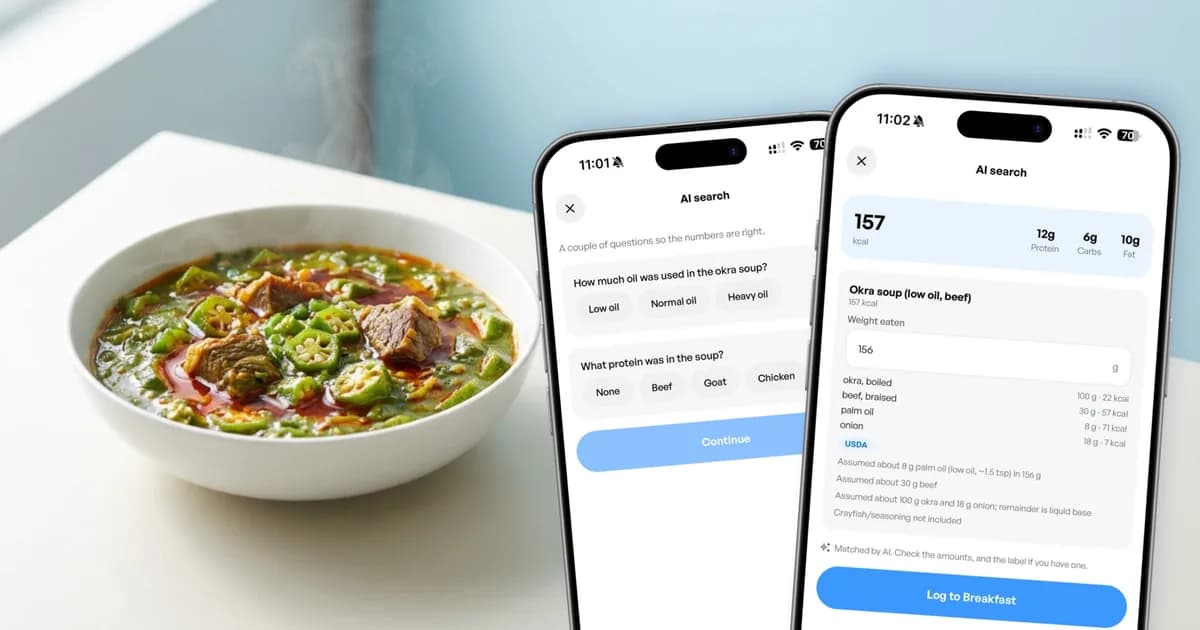
TrackMyCalorie, for example, is built on USDA FoodData Central for generic foods, with branded and restaurant items pulled in from FatSecret. When the AI recognises "grilled chicken breast" and estimates 130 grams, it looks up the verified per-100-gram value, about 192 calories per 100 grams for a roasted breast, and scales it to the portion. The AI handles recognition and portion; the database guarantees the nutrition is real and not made up. That division of labour is what separates a trustworthy tracker from a party trick.
What it gets right, and its one blind spot
AI calorie counters are strong at recognising foods, excellent at barcoded items, and fast enough that you actually keep logging, which is the whole game. Their one consistent blind spot is hidden fat. Oil, butter and dressing are calorie-dense and nearly invisible to a camera, so photo estimates tend to come in low. Research on photo apps found they typically undercount meals by a few hundred calories, almost all of it from fats the lens never saw. We dig into that in our piece on whether AI calorie trackers are accurate.
The fix is simple: tell the app how a dish was cooked. A good logger will even ask, when the answer matters. TrackMyCalorie takes its calories from verified database entries wherever a food exists, and only estimates when something genuinely is not in the database. Where judgement is needed, on portion and oil, it states the assumption it is using and lets you change it, so the hidden calories stop being hidden.
Getting the best from it
A few habits turn a decent estimate into a reliable one. Scan barcodes whenever there is one. Add cooking oil and butter as their own line. Give the app a portion reference, a hand, a utensil, or a word like "large." Correct the first estimate when it looks off, since most apps learn your patterns. And log consistently, because a steady small error still gives you an honest trend, which is what actually drives results. Set your daily target with our calorie calculator and let the logging do the rest.
People Also Ask
How does an AI calorie counter know the calories?
It does not calculate them from scratch. It recognises the food and estimates the portion, then looks up the calories in a verified food database like USDA FoodData Central. The AI handles the "what" and "how much"; the database supplies the trusted nutrition numbers.
Are photo calorie counters accurate?
They are close and consistent rather than exact. They do well on recognising foods and on barcoded items, but tend to underestimate meals because cameras miss hidden oil and fat. Telling the app how a dish was cooked closes most of that gap.
Can I just type my meal instead of taking a photo?
Yes. Natural-language logging lets you type or speak a meal like "two eggs and toast," and a language model turns it into foods and portions. It is often faster and more accurate than a photo for simple or mixed meals, because you tell it the amounts directly.
The bottom line
An AI calorie counter works in three steps: recognise the food, estimate the portion, and pull the real numbers from a verified database. It is fast and genuinely smart, with one honest limit around hidden fat and portion size. Help it with a scan, a note about the oil, and a portion cue, and it becomes a tracker you can actually trust.
Want to see it in action? Log your next meal with TrackMyCalorie — snap a photo, scan a barcode, or just type it, and watch it show its work.